
Decorative Countertop Edges: 5 Things to Think Through Before You Choose
The decorative countertop edge is back. After a decade of flat, eased edges, the ogee, bullnose, mitered, and waterfall profiles are returning for 2026. And almost every article you'll find is arguing about how they look. That's the least useful conversation you can have about them.
Your edge profile is not only a style decision. It's a structural one, a financial one, and an ergonomic one. It's also one of the easiest places for cost to slip into your bid without you noticing, because it gets priced at the fabricator stage, after most homeowners have stopped reading line items. I've watched this exact decision quietly add thousands to a kitchen. So before you fall for a profile on Pinterest, here are the five things I'd think through first.
Swipe through → quick micro remodel lessons
1. The remodel quote up charge is real, and it's often invisible
An eased edge usually runs $0 to $10 per linear foot and is often included in your base price. An ogee jumps to $25 to $60. A mitered or waterfall edge runs $60 to $100 and up. On a typical 40 to 55 linear foot kitchen, that's an extra $1,000 to $5,500 you may not have planned for.
Here's the part that bites people: if your bid doesn't name the specific edge profile, you're holding a guess, not a price. Make the fabricator write the profile into the quote.
2. The prettier the countertop countertop edge, the more it asks of you
Ogees, coves, and other decorative profiles have concave curves. Those curves are exactly where grease, crumbs, and food residue settle. (A toothbrush works better than you'd think.)
Nobody mentions this in the showroom, but the edge you fall in love with is also the edge you'll be cleaning around for the next fifteen years. Beautiful is fine. Just go in knowing the trade off.

3. Chipping risk changes with your natural stone, so this is two decisions, not one
Your edge profile and your slab material have to be chosen together. Marble is fragile on ornate edges. Quartzite is strong but expensive to repair, harder to fabricate, and not every shop will take it on. Quartz handles mitered waterfalls best. Porcelain often needs a mitered build-up to look right.
So when someone asks what edge you want, the real answer is "what edge works with my stone." Pair them on purpose.

4. The countertop edge is the part your body actually touches
This one gets skipped entirely. A sharp square edge is not safe, and on many materials it can void the warranty. (Yes, stop and go read the warranty provided by the quartz manufacturer) A softened profile like a bullnose mimics the natural angle of your forearm when you lean in to prep.
5. Remodel Resale rewards the right edge in the right home
In a luxury market, a mitered waterfall reads as craftsmanship and can support your price. In a mid-market home, $2,000 in ogee upgrades is an over-improvement that rarely comes back to you at sale. And a full bullnose on every surface dates a kitchen faster than almost anything else.
Match the edge to your home's tier, not to the prettiest example you saved.
You touch this edge every single day, with your hands, your hips, your kids' foreheads. Comfort and safety are not a downgrade from style. They're part of it.
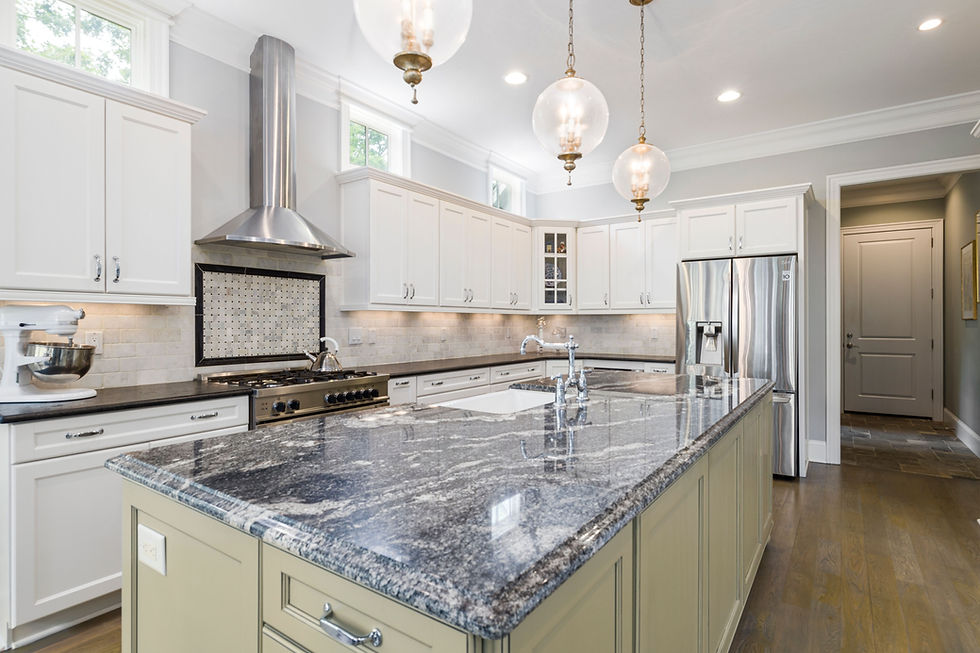
The move I'd actually make if I was planning a kitchen remodel.
Reserve the decorative profile for the island, where it shows and becomes the architectural moment of the room. Keep the perimeter on a simple eased or half-bullnose, where the daily prep, the cleaning, and the wear actually happen.
You get the high-end look exactly where the eye lands, and you lower the cleaning and maintenance load everywhere else. One smart split, two problems solved.
The truth underneath all five of these is the same. The edge profile is a real decision with real consequences, and it's usually treated like an afterthought you make standing in a showroom holding a sample. The homeowners who get it right are the ones who walked in already knowing the questions to ask.
Questions to ask before choosing a countertop edge
Is this edge included in the countertop quote?
Have you created this edge on this material before?
Is this edge an upgrade? If yes, how much does it add?
Does this edge work well with my countertop material or is there risk?
Will this edge affect seams, corners, or waterfall panels?
Is this edge harder to clean or maintain?
How will this edge look at the overhang?
Can I see a sample of this edge before approval?
Will this edge make the countertop look thicker, heavier, softer, or more traditional?

Planning your selections and want the full decision laid out before you sit with a fabricator?
_edited.jpg)


Comments